

Car Air Purifiers: Do They Actually Work
I’ll be honest, I was skeptical the first time I saw one of these little purifiers clipped to a car vent at an accessory shop. Felt like the automotive version of a Himalayan salt lamp — something that looks scientific but probably just sits there glowing. So I dug into it, and turns out the answer isn’t a simple yes or no. Some of these things genuinely do something. Others are basically expensive placebo. It all comes down to what’s actually inside the box.
First, is cabin air really that bad?
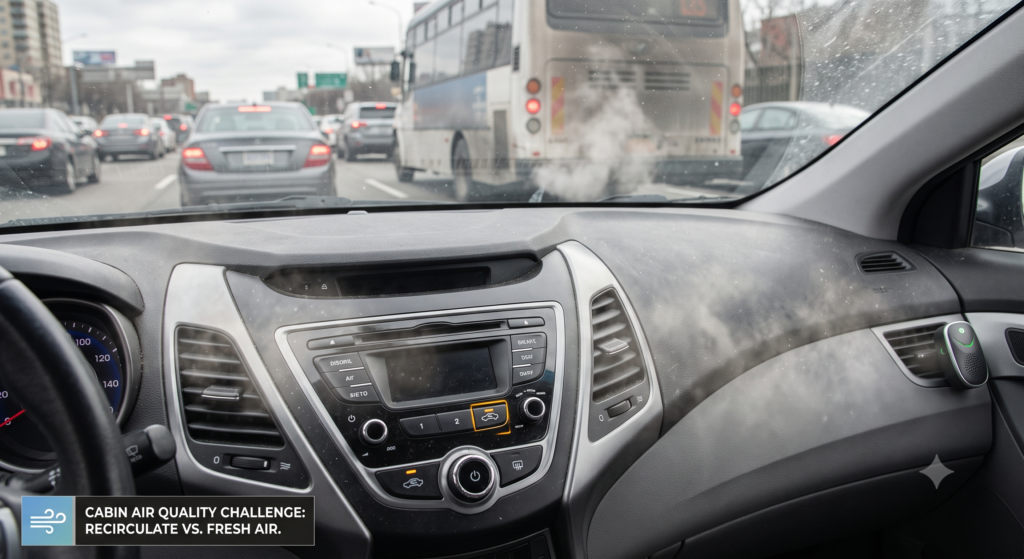
Yeah, kind of. This isn’t just something purifier companies made up to sell you a gadget. The air inside a closed car can get more polluted than the air right outside it, because all that exhaust, road dust, and pollen gets pulled in through the vents and then just… stays there. Especially with the windows up and the AC on recirculate.
And here’s the annoying part — recirculate mode, which is what you’d want for a purifier to actually keep up, barely exchanges the cabin air at all. Switch over to fresh-air intake and you get way more airflow, but now you’re just sucking in whatever’s floating around outside, including the exhaust from the car ahead of you at a red light. Kind of a lose-lose.
The tech inside these things (this is where it actually matters)
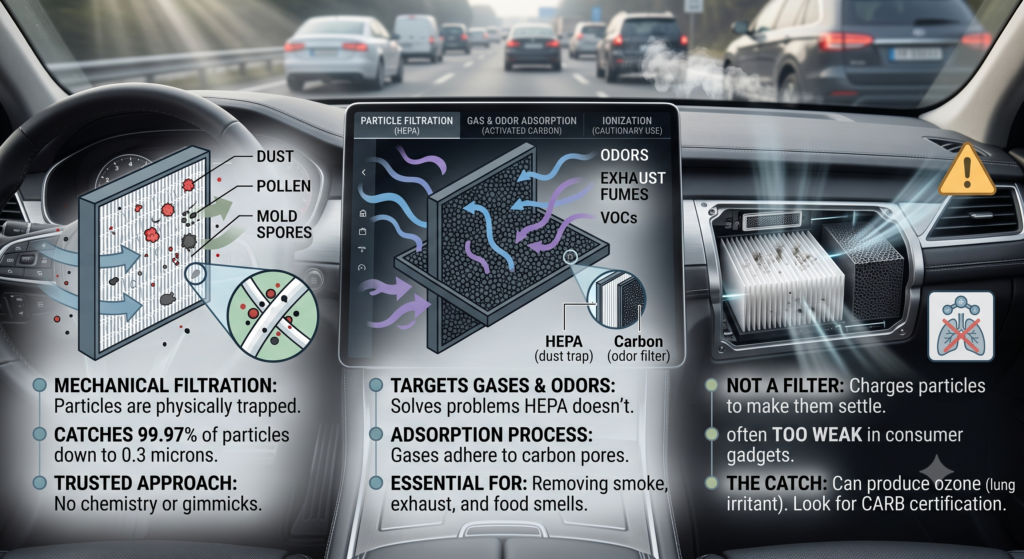
Most car air purifiers use one of three approaches, sometimes stacked together. Knowing which one you’re buying makes a real difference.
HEPA filters are the one I’d actually trust. It’s straightforward mechanical filtration — air gets pushed through a dense filter mesh, and particles physically get trapped. No chemistry tricks, nothing that needs “believing in.” A true HEPA filter catches 99.97% of particles down to 0.3 microns, so dust, pollen, mold spores, that kind of thing.
The honest limitation is size. A car unit is tiny compared to the HEPA purifier you might have in your living room, so its actual filtering capacity is small too. That said, decent compact units do show real, measurable drops in particulate levels over a 10-15 minute stretch with the windows closed. Quick trip to the store? You won’t feel it. Longer commute stuck in traffic? It’s doing something.
Activated carbon is the one people forget about, and it’s kind of the important one if what’s actually bugging you is smell rather than dust. HEPA filters don’t do anything against gases — exhaust fumes, VOCs, that lingering fast food smell. Activated carbon actually adsorbs that stuff. If odor is your main complaint, you want a purifier with a carbon layer, not just HEPA. They solve different problems.
Ionizers are where I’d tell you to slow down and read the fine print. These don’t filter air at all — they release charged ions that make particles heavier so they fall out of the air and stick to your dashboard, seats, whatever’s nearby, instead of your lungs. Sounds clever in theory. In practice, most consumer-grade ionizers are just too weak to do much of anything measurable. The ones that do work well are stronger than what’s in your typical $20 cupholder gadget.
There’s also a real catch: ionizers can produce trace ozone as a byproduct, and ozone is a lung irritant according to the EPA. Not exactly what you want pumping through your car if anyone on board has asthma. If you’re going to buy something with ionization in it, look for CARB certification specifically — that’s a decent signal the ozone output is controlled
So — worth buying or not?
Depends what you’re trying to fix.
Dust, pollen, fine particulate matter — get one with a real HEPA filter, and it’ll actually help, especially on longer drives with the windows up.
Smoke or lingering odors — HEPA alone won’t cut it, you need activated carbon in there too. And don’t expect miracles on cigarette smoke specifically; a small filter isn’t going to erase that.
Viruses, bacteria, “instant full-cabin purification” — I’d take those marketing claims with a grain of salt. These are small devices in a moving vehicle, and the evidence for rapid pathogen killing just isn’t strong.
Ionizer-only units with no HEPA filter mentioned anywhere — probably the weakest pick of the bunch, and the ozone thing is a legitimate concern, not fearmongering.
A few things I’d actually check before buying
- Look for “True HEPA” specifically. “HEPA-type” or “HEPA-like” is usually marketing-speak for a cheaper filter that doesn’t meet the real standard.
- If odor matters to you, make sure there’s activated carbon in there alongside the HEPA filter, not instead of it.
- Skip anything that’s ionizer-only, especially if anyone riding with you has allergies or asthma.
- Run it with the windows up and the fan on recirculate — that’s the only scenario where a small purifier stands a chance against incoming pollution.
- Keep your expectations in proportion to the size of the device. It’s a helper, not a replacement for actually swapping out your car’s cabin air filter every so often.
Where I landed on this
They’re not a scam, but they’re not magic either. A proper HEPA-plus-carbon unit does real work — measurable, just modest, because of how small these things are. The ionizer-heavy ones are the ones I’d be more careful about, both because they tend to underdeliver and because of the ozone angle.
If you’re driving through heavy traffic or a genuinely polluted city every day, I think it’s a reasonable thing to add to your car. If your commute is mostly quiet roads with a cracked window, honestly your money’s better spent just replacing your cabin air filter on schedule — the boring, unglamorous thing that actually does most of the heavy lifting and that everyone forgets about anyway.
Comments
Be the first to share your thoughts.